
Are Pill Containers Airtight? What Actually Protects
A pill organizer can look perfectly closed, survive a commute, and still allow air and moisture to move through tiny gaps over time. So, are pill containers airtight? Most standard pill containers are not. They are designed to separate doses, not to create the controlled storage environment that many vitamins, capsules, and medications receive in their original packaging.
That distinction matters when your daily routine includes premium supplements. Magnesium, probiotics, fish oil softgels, gummies, powders in capsule form, and botanical blends can all be sensitive to heat, humidity, light, or simple exposure to the air around them. A better pill case does not need to replace the manufacturer’s bottle for long-term storage. But it should offer more thoughtful protection than a thin, rattling plastic box with a loose lid.
Are Pill Containers Airtight? Usually, No
An airtight container creates a seal that prevents air exchange between the inside and outside. In practical terms, that requires precise mating surfaces, a gasket or sealing ring, and a closure engineered to maintain pressure against that seal.
Most weekly pill organizers do not have those features. Their snap lids are made for easy opening, and their molded plastic compartments often have small tolerances around the lid edge. That is enough to keep a tablet in its assigned day, but not enough to promise an airtight barrier. Some are also prone to warping, loosening, or popping open in a crowded tote bag.
Even containers marketed as "sealed" or "secure" may simply be spill-resistant. That is a useful feature, but it is not the same as airtight. A case can prevent capsules from escaping while still allowing moisture and air to enter gradually.
Why the original bottle is different
Supplement brands frequently use bottles with induction seals, tight threaded caps, moisture-control liners, and desiccant packets. Those details are there for a reason: the formula was stability-tested in that packaging. Once you move a dose into a pill case, you are changing its storage conditions.
For a few days of organized use, that may be entirely reasonable. For weeks or months of pre-filled storage, especially in a humid bathroom or hot car, it is a very different proposition. The smartest approach is to keep the bulk supply in its original container and portion out only what you need for the near term.
What Air and Humidity Can Do to Supplements
Humidity is often the bigger concern. Moisture can make tablets soften, gummies stick together, capsules become tacky, and powders clump inside capsules. It can also speed up degradation in ingredients that are naturally less stable once exposed to air and light.
The effect is not always dramatic. A vitamin might look normal but lose potency over time. Other changes are obvious: a fish oil softgel feels unusually sticky, a capsule shell becomes brittle, or a tablet develops spotting or an odd smell. If a supplement has changed color, texture, odor, or shape, do not assume it is still suitable just because it remained inside a closed compartment.
Heat makes the problem more aggressive. A pill case left in a car, at the beach, or near a sunny window can get far warmer than the room-temperature conditions listed on most labels. An airtight seal would not solve overheating anyway. Protection is layered: thoughtful construction helps, but where you store the case matters just as much.
The Protection That Matters in a Daily Pill Case
For a daily organizer, the goal is not always laboratory-grade airtight storage. It is dependable, short-term protection that makes your routine easier without treating expensive supplements like an afterthought.
Start with closure security. Every compartment should stay closed when the case is jostled, tipped, or carried upright and sideways. A lid that springs open at the bottom of your bag turns a wellness routine into loose capsules, lint, and waste.
Then consider the materials. Cheap plastic organizers can stain, retain odors, scratch easily, and feel questionable when they hold products you take every day. A premium system should be made with toxin-conscious materials, smooth interiors that are easy to clean, and durable components that hold their shape through daily use.
Finally, look at the design of the individual compartments. Separate, removable pods reduce the chances of mixing doses or exposing an entire week’s supply every time you open one section. A well-designed closure also creates a more consistent barrier against everyday dust, accidental splashes, and the ambient humidity of a busy bathroom or travel bag.
Spill-proof is not just a nice extra
A spill-proof pill case cannot make every supplement shelf-stable forever. What it can do is protect the daily portion you intentionally packed. That makes it easier to keep a few days of capsules in your work bag, carry a day’s stack to the gym, or travel without bringing a cabinet’s worth of original bottles.
The best designs make that protection feel effortless. There is no need to wrap flimsy organizers in rubber bands or question whether the lid will hold when you pull it out at dinner. Good engineering should disappear into the ritual.
How Long Can Pills Stay in a Container?
There is no universal answer because the ingredient, dosage form, climate, and container all matter. A hard, coated tablet is generally more forgiving than a probiotic, a softgel, an effervescent tablet, or a moisture-sensitive capsule. Prescription medication may also have specific pharmacy instructions that should always take priority.
For most people, a practical rule is to fill a pill organizer for the week ahead rather than pre-sorting several months at once. Keep the remaining supply in its original bottle, with its cap, label, and desiccant packet intact. This approach preserves the manufacturer’s storage setup while giving you the convenience of a ready-to-go daily system.
If you live somewhere hot or humid, shorten that window when possible. Do not store your filled case in the bathroom, beside the stove, or in a parked car. Choose a cool, dry drawer, bedside table, or travel pouch away from direct sunlight.
What to Look for Beyond the Word "Airtight"
When shopping for a pill container, "airtight" can be an appealing label, but it should not be your only filter. Ask whether the product explains how it seals, whether it uses a gasket, and whether the claim applies to each individual compartment or only the outer case.
Also consider how it fits into your life. A bulky seven-day organizer may work on a countertop but fail completely for travel. Tiny compartments may be fine for a single tablet but frustrating if your routine includes large capsules, softgels, or several supplements at once. A case should accommodate your actual stack, not an imaginary minimalist routine.
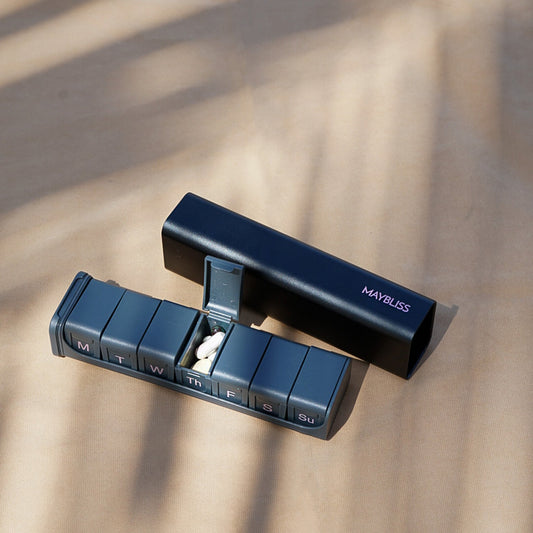
Modularity is especially useful here. With a pod-based system, you can take one day’s essentials while leaving the rest at home. That limits unnecessary exposure and keeps your bag lighter. Maybliss approaches this with a patented magnetic pod-and-tray format that brings polished design, durable construction, and intentional portability to an object most people have been trained to accept as disposable.
A Better Way to Portion Your Routine
Treat your pill case as a short-term command center, not a warehouse. Refill it on a consistent day, check that each capsule is dry and intact, and return the original bottles to a cool, dry place. If a supplement comes with a desiccant packet, leave that packet in the original bottle rather than moving it into a small compartment where it could touch pills directly.
For travel, pack only the amount you expect to use plus a modest buffer for delays. Keep the case out of direct sun, and do not leave it in checked luggage or a hot glove compartment. If you are carrying prescription medication, retain the original labeled container when appropriate, particularly for longer trips or international travel.
A beautiful pill case should make consistency more likely. But it should also respect the products inside it. The most elevated routine is not the one with the most complicated storage setup - it is the one that keeps your daily essentials organized, protected, and ready when you are.