
Can Capsules Absorb Moisture? What to Know
That capsule that used to feel smooth and dry but now sticks to its neighbors is not just an aesthetic issue. Can capsules absorb moisture? Yes - many can take on moisture from humid air, and the results can range from a slightly tacky shell to a supplement that no longer performs as intended.
For anyone investing in a considered wellness routine, storage is part of the product experience. Your magnesium, probiotics, fish oil, and carefully selected daily stack deserve better than a humid bathroom counter or a flimsy organizer with gaps around the lid.
Can Capsules Absorb Moisture From the Air?
Capsules can absorb moisture, although how much and how quickly depends on the capsule material, the ingredients inside, the local climate, and how long the product is exposed. Gelatin capsules are especially sensitive to changes in humidity. In damp conditions, they can become soft, sticky, or misshapen. In very dry conditions, they may become brittle and crack.
Vegetarian capsules, often made from hypromellose or pullulan, can also be affected by moisture. They may offer different stability characteristics than gelatin, but they are not immune to humidity. The powder, oil, or active ingredients inside can be vulnerable too. A capsule shell may look acceptable while the contents have clumped, degraded, or begun to break down.
Moisture is not always visible at first. It can enter when a bottle is repeatedly opened in a steamy room, when capsules are transferred to an unsealed case, or when a travel bag moves between air-conditioned spaces and hot outdoor conditions. That gradual exposure is why thoughtful storage matters long before a capsule looks obviously compromised.
What Humidity Can Do to Your Supplements
A little humidity does not automatically ruin every capsule. Supplement formulas are different, and manufacturers test products for specific storage conditions. Still, moisture creates real risks that are worth avoiding, particularly with high-value supplements you take every day.
The most obvious sign is sticking. Capsules may cling together, adhere to the container, or feel gummy to the touch. Powders can clump, making a capsule feel oddly firm or uneven. Softgels can become tacky, leak, or fuse together when heat and humidity work together.
There is also a performance concern. Water can accelerate chemical changes in certain ingredients, especially when a formula includes moisture-sensitive vitamins, botanicals, enzymes, or probiotics. It can affect how a capsule shell disintegrates, which may alter the way the product releases after you take it. Moisture can also create more favorable conditions for microbial growth in some circumstances, particularly once a product has been exposed repeatedly.
The trade-off is simple: transferring capsules out of their original packaging makes daily use easier, but it can remove some of the protection built into that bottle. Original bottles often include a tight closure, a desiccant packet, and an opaque exterior designed for the specific formula. A pill case should make your routine more elegant without treating storage as an afterthought.
Signs a Capsule Has Been Exposed to Too Much Moisture
Trust your senses before you add questionable capsules to your daily routine. A capsule does not need to be visibly wet to signal a problem.
Look for capsules that are stuck together, unusually soft, swollen, cracked, warped, or coated in a tacky film. With two-piece capsules, watch for shells that have separated, collapsed, or show changes in color. For softgels, leaking oil, a cloudy surface, or an unusually strong odor are clear reasons to stop and assess the product.
A powder-filled capsule can be harder to judge. If it feels lumpy, looks discolored, or has a different smell than when you opened the bottle, do not assume it is fine. Check the manufacturer’s storage guidance and expiration date. For prescription medications, do not guess: ask a pharmacist whether the product is still safe to use and how it should be stored.
It is also worth separating moisture damage from normal variation. A few capsules may have a slight difference in appearance because of natural ingredients or manufacturing variation. But a sudden change after a beach trip, a humid week, or storage in the bathroom is a useful clue.
The Bathroom Is a Poor Place for Capsule Storage
The medicine cabinet feels convenient. It is also one of the least controlled places in the home. Showers create repeated surges of heat and humidity, and opening a cabinet or bottle during that cycle invites moist air directly around your capsules.
The kitchen can present similar challenges. A case left near the stove, dishwasher, sink, or coffee machine may face steam, splashes, and temperature swings. Window ledges and cars are worse still, combining direct light with heat that can soften softgels and stress capsule shells.
A cool, dry drawer or cabinet away from direct sunlight is generally the better choice, provided the product label does not give different instructions. Room temperature does not mean any room or any surface. It means a reasonably stable environment, protected from steam and extreme heat.
How to Protect Capsules Without Making Your Routine Harder
The best storage system is one you will actually use. If organizing supplements feels tedious, capsules end up loose in a bag, on a counter, or transferred days too far in advance. A better approach combines short-term portability with sensible protection.
Keep the bulk of your supply in its original container whenever possible. That preserves the manufacturer’s intended barrier and any included desiccant. Then transfer only the amount you need for the day, commute, workout, or short trip into a well-designed pill case.
Choose a case with secure, individual compartments and a dependable closure. Loose lids and shared compartments let capsules collide, spill, and sit in a larger pocket of trapped air. A durable, thoughtfully engineered system protects the routine from the chaos of a tote bag, carry-on, or crowded desk drawer.
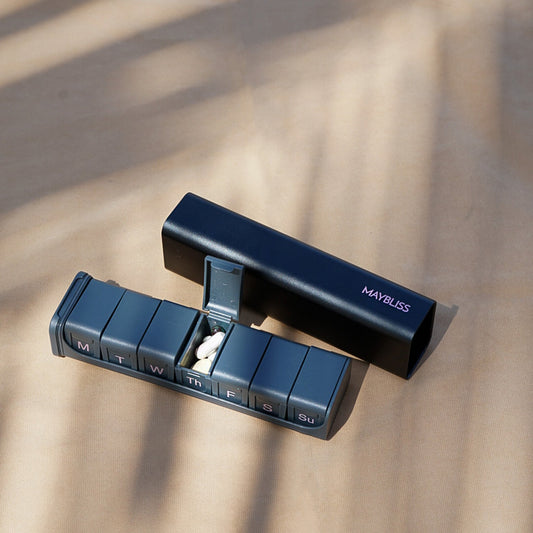
Maybliss brings that standard to daily organization with a patented magnetic pod-and-tray system designed to keep portions contained, polished, and ready to go. The point is not to store a month of moisture-sensitive supplements in a travel pod. The point is to create a refined, protected handoff between your original bottle and your real life.
If you live in a particularly humid climate, keep transfers even shorter. Loading a few days at a time may be perfectly practical for many stable products, while probiotics, delicate botanicals, and capsules with specific label instructions may call for daily loading instead. This is one of those details where the formula should lead the decision.
Should You Add a Desiccant Packet to a Pill Case?
Sometimes, but with restraint. A food- or supplement-safe desiccant packet can help manage humidity in an appropriately sized storage container, yet it is not a universal fix. It should never touch loose capsules if the packet could tear, and it cannot compensate for a case that is frequently opened in a steamy environment.
Do not move desiccant packets from one supplement bottle to another unless the manufacturer says it is appropriate. Different products have different moisture needs, and some packaging components are designed for a specific bottle size and formula. More drying is not always better either. Gelatin capsules can become brittle in overly dry conditions.
For most people, the smarter move is less complicated: store bulk bottles correctly, avoid bathroom and car storage, keep travel quantities modest, and use a secure case built for daily movement.
A More Intentional Way to Carry Your Daily Stack
Capsules are designed to protect what is inside them, but the shell itself is still a material with limits. Humidity, heat, light, and poor storage habits can quietly turn premium supplements into a sticky, compromised mess.
Treat your daily stack with the same discernment you used when choosing it. Keep it cool and dry, carry only what you need, and give each capsule a secure place between home, work, and wherever the day takes you.