
How Long Do Capsules Last? Storage Matters
A capsule that looks perfectly fine can still be a poor bet after months in a steamy bathroom, a hot car, or the bottom of an overfilled tote. If you spend real money on magnesium, probiotics, fish oil, adaptogens, or a carefully selected daily stack, storage is not an afterthought. It is part of protecting the routine you built.
So, how long do capsules last? The short answer is: until the manufacturer’s expiration date, provided they have been stored as directed. The more useful answer is that a capsule’s lifespan depends on its ingredients, shell material, packaging, and exposure to heat, humidity, light, and air. A date on the bottle gives you a boundary. How you handle the bottle and your daily supply determines how well the capsules hold up before then.
How Long Do Capsules Last Before They Expire?
Most unopened supplement capsules remain at their best through the printed expiration or “best by” date. That date is the manufacturer’s assurance that the product should retain its labeled potency and quality when stored correctly. It is not a suggestion to ignore, and it is not a guarantee that a capsule kept in rough conditions will stay pristine until that day.
For many supplements, the date may fall one to three years after manufacturing. Stable dry ingredients, such as many mineral capsules, often hold up better than formulas containing oils, live cultures, delicate botanicals, or highly reactive nutrients. Fish oil softgels, probiotics, and certain antioxidant formulas deserve especially close attention because their ingredients can degrade more readily.
After the expiration date, the most common issue is reduced potency. A capsule may not deliver the amount listed on its label, even if it has not visibly changed. With prescription or over-the-counter medication, follow the label, pharmacist, or prescriber’s guidance rather than making assumptions based on appearance. Do not use damaged, expired, or questionable medication without professional advice.
The Printed Date Is Only as Good as the Storage
A bottle stored unopened in a cool, dry cabinet is very different from one opened daily next to a shower. Every opening lets in fresh air and moisture. Every warm commute or sunny windowsill adds stress. Those conditions can accelerate degradation long before the date printed on the label.
Think of the expiration date as the finish line under normal conditions. Heat, humidity, and poor handling can move that finish line closer.
What Makes Capsules Break Down Faster?
Capsules are designed to protect their contents until you take them, but they are not indestructible. Their shells respond to the environment, and so do the ingredients inside.
Humidity is often the biggest threat. Gelatin capsules can soften, stick together, warp, or become brittle as moisture levels shift. Plant-based capsules, often made with hypromellose, can also be affected by excess humidity, though the exact response varies by formula. Moisture can be particularly problematic for powders that clump, probiotics that lose viability, and ingredients that react with water.
Heat is another major factor. A car, gym bag left in the sun, or pocket of luggage sitting on a tarmac can get much warmer than a home. Softgels may leak or fuse together in high heat. Oil-based ingredients can oxidize, changing in quality before you notice an obvious visual difference.
Light and oxygen matter, too. Some nutrients are light-sensitive, while oils and certain botanical compounds can deteriorate with air exposure. This is why original packaging often uses opaque bottles, tight seals, desiccant packets, or blister packs. Those details are not filler. They are part of the product’s protective system.
Should You Keep Capsules in Their Original Bottle?
For long-term storage, the original bottle is usually the safest place for supplements. It carries the expiration date, lot number, dosing instructions, and any storage requirements. It may also include a desiccant or other packaging designed for that specific formula.
That does not mean you have to choose between a cluttered cabinet and carrying multiple full-size bottles everywhere. A well-designed organizer can hold a short, intentional supply for the day, the workweek, or a trip while the main bottle stays sealed at home. The key is to transfer only what you will use reasonably soon and keep the organizer clean, dry, and out of direct heat.
This distinction matters. A beautiful daily system should make consistency easier, not turn a month’s worth of sensitive supplements into a loose collection exposed to every change in your environment.
When a Pill Organizer Makes Sense
A pill organizer is ideal when you need convenience without the chaos of loose capsules rolling around in a bag. It can help you pre-portion a daily routine, see whether you have taken your supplements, and travel without bringing a medicine-cabinet-sized collection of bottles.
Use it thoughtfully. If your formula says “refrigerate,” “store in a cool place,” or includes a desiccant because moisture control is critical, keep the bulk supply in its original packaging and transfer only a minimal amount. Probiotics and certain specialty supplements may have stricter requirements than a standard vitamin capsule.
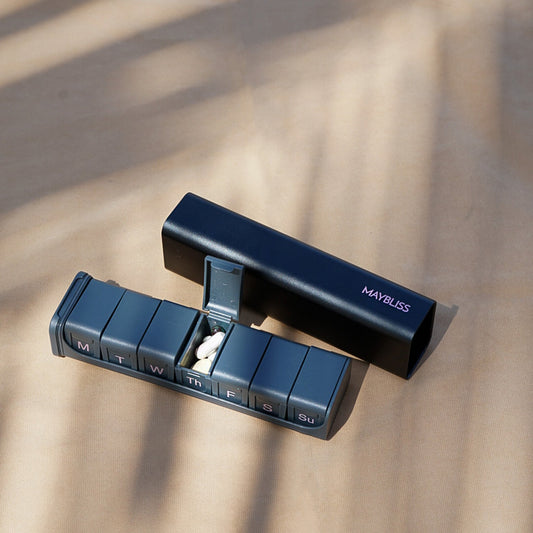
A premium modular system such as Maybliss is built for that real-life middle ground: a polished, portable place for your near-term routine, rather than a flimsy plastic box that feels disposable and leaves expensive capsules vulnerable to spills and disorder.
Signs Your Capsules May No Longer Be Good
Do not rely solely on smell or appearance to judge a supplement’s potency, but visible changes are a clear reason to pause. Inspect capsules before taking them, especially if they have spent time in heat or humidity.
Watch for these signs:
- Capsules that are stuck together, softened, cracked, leaking, or unusually brittle
- Powder that has clumped, changed color, or escaped from the capsule shell
- Softgels that look cloudy, misshapen, melted, or fused together
- An unfamiliar rancid, sour, or strongly off odor, especially in oil-based formulas
- Missing labels, unclear expiration dates, or pills that cannot be confidently identified
The Right Way to Store Daily Capsules
The best storage solution is usually simpler than people make it. Choose a cool, dry, dark location away from the stove, shower, and direct sun. A bedroom drawer, pantry shelf away from heat, or closed cabinet outside the bathroom is often better than the places people reach for first.
Keep bottle lids tightly closed, and leave the desiccant packet inside unless the label says otherwise. Avoid mixing capsules from different products in one compartment if you need to preserve identification, follow different dosing instructions, or track expiration dates. Do not leave capsules loose in a car, in checked luggage for extended periods, or in a bag that will sit outdoors.
For travel, pack only what you need plus a small buffer. Keep capsules in a protective case inside your personal item when possible, where temperatures are generally more stable than a trunk or checked bag. If you are traveling with a temperature-sensitive formula, plan around the manufacturer’s instructions instead of hoping any organizer will solve a formulation-specific storage need.
Capsule Shelf Life Is Also a Routine Question
The best supplement is not the one hidden behind six bottles in a crowded cabinet. It is the one you can take consistently, confidently, and without wondering whether it was crushed under a laptop charger two weeks ago.
A considered storage system protects more than capsule shells. It protects clarity around what you take, when you take it, and whether your carefully chosen wellness routine is still in the condition you intended. Keep the bulk supply properly stored, carry only what you will use soon, and let every capsule earn its place in your day.