
How to Prevent Vitamin Mixups in Your Routine
Your supplement routine should not require detective work at 7 a.m. Yet once a counter fills with similar white bottles, loose packets, and look-alike capsules, even a carefully built wellness stack can become confusing. Learning how to prevent vitamin mixups is less about becoming hyper-organized and more about creating a system that makes the right choice obvious every time.
That matters when you have invested in quality. Magnesium, vitamin D, probiotics, fish oil, prenatal vitamins, prescription medications, and specialty formulas often have different timing, dosing, and storage needs. Taking the wrong item is frustrating. Taking two doses because you cannot remember whether you already took one can be riskier. A well-designed routine removes that uncertainty without making your countertop look like a pharmacy.
Why vitamin mixups happen in the first place
Most mixups are not caused by carelessness. They happen when a routine relies on memory instead of visual cues. Bottles with nearly identical labels sit side by side. Capsules are transferred into an unmarked container for travel. A partner’s vitamins share the same cabinet. The afternoon supplement gets confused with the morning one because both are in the same oversized bottle.
The problem gets sharper with minimalist packaging. A clean label may look gorgeous on a shelf, but it can be difficult to distinguish at a glance when several products use the same color palette. Capsule shape is not a reliable identifier, either. Many supplements are white, beige, clear, or softgel-sized, and lighting can change how they appear.
Travel adds another layer of risk. Tossing loose pills into a baggie may seem efficient, but it removes the label, the dose instruction, and the separation that keeps a daily routine clear. It also exposes expensive supplements to spills, crushing, humidity, and the kind of friction that turns a polished wellness habit into clutter.
How to prevent vitamin mixups with a better system
The best system creates a simple chain of certainty: identify the supplement, separate it by purpose or timing, protect it in storage, and make completed doses visible. If any link is missing, your routine is more dependent on recall than it needs to be.
Assign each supplement a clear role
Start by deciding what each item is for and when you actually take it. Morning, with food, before bed, workout days, and as needed are more useful categories than an undifferentiated pile of bottles. If a product is taken only once a week or only on certain days, give it a dedicated place rather than mixing it into an everyday supply.
Write the routine down once, even if you think you know it. Include the product name, strength, number of capsules or tablets, and timing instructions. This is especially useful if a clinician has recommended a particular schedule or if you take both vitamins and medication. Your storage system should reflect that plan, not replace it.
Separate by time, not just by type
A common organizing mistake is grouping all vitamins together, all softgels together, or all capsules together. That might look tidy, but it does not prevent mistakes when it is time to take them. Instead, organize around the moment of use.
For example, your morning compartment may hold vitamin D and a multivitamin, while your evening compartment holds magnesium. A travel pod for midday may contain only what belongs in that dose. When every compartment answers one question - “What do I take now?” - there is far less room for hesitation.
This approach also reveals whether your routine is realistic. If a single dose requires an overstuffed compartment or several loose containers, it may be time to rethink the format, timing, or number of products you carry. Convenience is not a minor detail. It is part of consistency.
Label the container, not just the original bottle
Original bottles should stay labeled, but a transferred dose needs its own identity. A container that simply holds pills is not enough if you cannot tell what is inside or when it is meant to be taken. Use labels that name the timing, such as “AM,” “PM,” or “Travel Day 1,” and add initials only when they are meaningful to you.
If more than one person uses the same storage area, include the person’s name or a distinct color cue. Do not rely on “I know which one is mine.” That confidence disappears quickly during a rushed morning, after a long flight, or when someone else is putting away laundry and toiletries.
For supplements that look similar, use a second identifier. A small note inside your routine tracker, a photo of the capsule beside its name, or a consistent compartment placement can help. The goal is not to turn every dose into a research project. It is to eliminate guessing.
Build in a visible proof of completion
One of the most useful habits is making it obvious whether you have taken a dose. An open bottle does not prove much. It may have been opened yesterday. A handful of capsules on the counter is even less reliable.
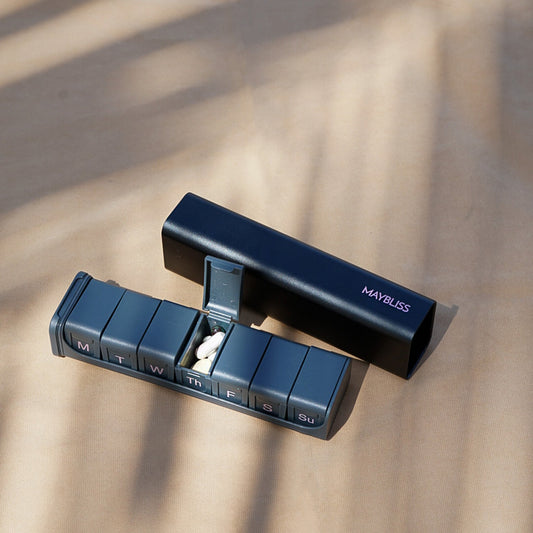
A daily organizer with designated compartments creates a clean before-and-after signal. Full means not yet taken; empty means complete. Reset the organizer at the same time each week, ideally when you can check the original labels and refill without rushing. This small ritual can prevent accidental double-dosing and make missed doses easier to spot.
Do not pre-sort more than you can confidently manage. A full month may sound efficient, but it increases the chance of confusing a changed dosage, an expired product, or a newly discontinued supplement. One to two weeks is often a smart balance between convenience and control. It depends on how stable your routine is and how often your healthcare provider adjusts it.
Choose storage that protects the contents
Vitamin mixups are not only about taking the wrong pill. A capsule that has melted, absorbed moisture, or leaked into another compartment is no longer a clean, reliable part of your routine. Thin drugstore organizers can pop open in a tote, crush in luggage, or leave supplements exposed to the humidity of a bathroom counter.
Choose a case with secure closures and separate compartments that keep doses from migrating. Store the bulk of your supplements in a cool, dry place unless the product label says otherwise. Bathrooms are often convenient, but shower steam and temperature swings are not ideal for many vitamins, probiotics, or oils.
For a more elevated setup, a modular storage system such as the Maybliss BlissPod Pro keeps individual doses contained in sleek, magnetic pods rather than loose in a disposable plastic box. That separation is especially useful when you want a polished travel routine without combining different capsules in a single unmarked compartment.
Treat travel doses differently from home storage
Travel is where good systems tend to break down. Before a trip, pack the exact number of doses you need plus a small buffer for delays. Keep each day or timing group separate, and bring a written list of what you packed. If a supplement is temperature-sensitive, check its label before leaving it in a hot car, checked luggage, or a sunny hotel room.
For prescription medication, preserving the original labeled container may be the better choice, particularly for air travel or international trips. Vitamins are generally simpler to transport, but clear organization still saves time at security, in hotel rooms, and on early departures when your brain is not fully online.
A five-minute weekly mixup check
Once a week, take five minutes to audit your setup before refilling. This is the moment to catch small errors before they become a pattern:
- Compare each supplement with its original label and confirm the dose.
- Remove anything expired, damaged, melted, or discolored.
- Check that timing labels still match your current routine.
- Keep prescriptions, children’s vitamins, and another person’s supplements clearly separate.
- Clean and fully dry compartments before adding a new set of doses.
When organization is not enough
No organizer can answer clinical questions. If you are pregnant, managing a health condition, taking prescription medication, or starting a high-dose supplement, ask a pharmacist or healthcare professional to review your routine. The same applies if you notice duplicate ingredients across products or are unsure whether two supplements can be taken together.
Organization is the design layer that helps you follow the plan safely. It is not a reason to combine products casually, change a dose because a compartment has extra space, or assume natural means risk-free.
A beautiful routine is not one with the most bottles on display. It is one where every dose has a place, every compartment has a purpose, and you can move through your day without wondering what is in your hand.