
Pill Case That Prevents Spills, Designed Better
A pill case that prevents spills is not a minor upgrade when your routine includes premium supplements, prescriptions, or a carefully built wellness stack. It is the difference between opening your bag with confidence and finding capsules scattered beneath your laptop, fish oil softgels rolling under the car seat, or powdered supplements dusting the bottom of your tote.
The standard drugstore organizer was built to be inexpensive, not exceptional. Its thin plastic lids flex, compartment doors pop open, and bulky layouts make it feel like a medical accessory rather than something you would want on your desk, nightstand, or restaurant table. When you invest in your wellness routine, the container deserves more intention.
Why pills spill in the first place
Most spills do not happen because someone is careless. They happen because conventional organizers use flimsy hinges, shallow compartments, and closures that depend on a tiny plastic tab remaining perfectly aligned. Add the pressure of an overpacked bag, the movement of travel, or one rushed morning, and that design starts to fail.
The problem becomes more expensive when your compartments hold more than basic multivitamins. Large capsules, softgels, probiotics, magnesium, prescription medications, and small wellness essentials all need room to sit securely without forcing a lid upward. A case can look closed while still being under tension. That is often when it opens at exactly the wrong time.
There is also a practical distinction between a case that simply has lids and one designed to contain its contents. Real spill prevention comes from a system: secure individual compartments, a protective outer structure, and a layout that does not invite you to overstuff one small section.
What a pill case that prevents spills should do
A polished exterior alone is not enough. The best organizer should make your routine easier at home and more reliable away from it, without turning every dose into a fussy process.
Keep each dose contained
Start with compartment security. Each section should close decisively and stay closed through the normal realities of a day: being dropped into a work bag, carried through an airport, or jostled alongside keys and chargers. Individual pod-style storage is especially useful because it prevents one opened section from exposing an entire week of supplements.
Modularity adds another layer of control. Rather than taking a large organizer everywhere, you can bring only the pods you need for a meeting, an overnight stay, or a weekend trip. That reduces bulk while keeping your larger routine organized at home.
Protect what you paid for
A spilled supplement is not just inconvenient. It can mean wasted money, contamination from the bottom of a bag, and uncertainty about what you are taking later. Quality storage keeps pills separated from loose debris and gives them a dedicated place between purchase and use.
Protection also means being thoughtful about the container material. Many people choose supplements carefully, reading labels and prioritizing ingredients, yet store them in cheap plastic that feels disposable from the first use. A premium case should be made for daily contact, cleaned easily, and built to retain its shape after years of use.
For toxin-conscious shoppers, third-party-tested materials are worth looking for. The point is not to turn a pill organizer into another wellness worry. It is to remove an obvious weak link from a routine built around feeling your best.
Travel without the pillbox look
The right case should be discreet enough to use anywhere. You should not need to pull out a rattling, translucent plastic box at a cafe or hide it at the bottom of your bag. A sleek, compact design belongs naturally beside the rest of your essentials.
That does not mean choosing style over performance. The strongest products treat design as part of the function. A sturdy, well-finished exterior protects the compartments inside, while a satisfying closure and orderly layout make it more likely that you will actually use the system every day.
The material question: plastic, aluminum, and peace of mind
Not every pill case needs to be metal. A simple plastic organizer may work for a low-cost, at-home medication routine where it stays in one drawer and is replaced often. But that is a different use case from carrying valuable supplements every day.
Thin plastic is prone to scratches, warping, lingering odors, and hinges that wear down with repeated opening. It can also make a premium routine feel temporary. If you travel frequently, keep supplements in a warm car, or want an organizer that looks considered rather than clinical, a more durable material makes sense.
Anodized aluminum offers a compelling balance of strength, weight, and elevated finish. It feels substantial without being cumbersome and resists the tired, cloudy appearance common to inexpensive pillboxes. The interior storage components still matter, of course. Look for materials that have been intentionally selected and tested for daily use, not merely added because they are inexpensive to manufacture.
No portable case can reverse the effects of extreme heat or humidity. Certain supplements, especially probiotics and softgels, may have storage directions that should take priority. A well-designed case provides a more protected home for daily transport, but it is not a substitute for following the label or leaving heat-sensitive products in a climate-controlled environment.
A smarter system for changing routines
The trouble with a one-piece weekly organizer is that life rarely follows a perfect seven-day pattern. Perhaps your weekday stack includes focus support and electrolytes, while your weekend routine is simpler. Perhaps you take daily medication but only pack supplements for travel. A fixed grid forces every routine into the same format.
A modular system lets the case adapt instead. Keep a full set arranged in a tray at home, then lift out the exact pod or pods needed for the day. It creates a clean visual checkpoint: the pod is either packed or it is not. There is less guesswork, fewer loose bottles, and no need to decant an entire week just to leave town for two nights.
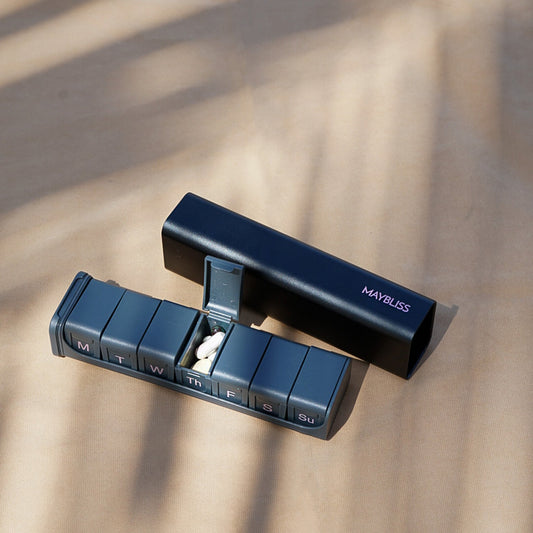
This is where thoughtful engineering changes a habit. Maybliss built the BlissPod Pro around a patented magnetic pod-and-tray design, pairing secure, portable storage with an object that looks at home in a well-designed space. The magnetic system keeps the routine organized in one place while making individual doses easy to take with you.
How to choose the right spill-resistant case
Before buying, consider the pills you actually take rather than the number of compartments advertised. A case with seven tiny sections may be perfect for tablets but frustrating for larger capsules, softgels, or a multi-supplement stack. Check capacity, interior dimensions, and whether compartments can be used independently.
Then consider your real movement. If your organizer never leaves the kitchen, a compact fixed case may be enough. If it moves from bedroom to office to carry-on bag, prioritize durable construction, dependable closures, and a format that separates only the doses you need.
Finally, pay attention to the experience of opening it. This sounds small, but it determines whether the product becomes part of your routine or ends up in a drawer. The lid should feel intentional, the compartments should be easy to access, and the case should be beautiful enough that you do not resent leaving it visible.
A better wellness routine is often built from small moments of friction removed. Choose a case that keeps your supplements protected, your bag clean, and your next dose exactly where you expect it to be.