
Vitamin Cases That Protect Your Daily Stack
Your supplements may be premium, but the container holding them often is not. Vitamin cases are easy to dismiss as a small purchase - until fish oil softgels leak into a tote, a week’s worth of capsules scatters through airport security, or a cheap plastic organizer makes an otherwise thoughtful routine feel disposable.
A better case does more than separate pills by day. It protects the products you paid for, removes friction from your routine, and gives your wellness essentials a place that belongs on your vanity, desk, or dinner table. The right one should feel less like a drugstore afterthought and more like a well-made daily tool.
What Great Vitamin Cases Actually Do
A basic pillbox answers one question: where do the pills go? A thoughtfully designed vitamin case answers several more. Will the compartments stay closed in a bag? Can you take one day’s supplements without packing the entire week? Is the material appropriate for something you ingest every day? Will you actually want to use it when you are rushing out the door?
Those details influence consistency. When your magnesium, multivitamin, probiotics, and evening capsules are already portioned, you are less likely to skip them because the bottles are buried in a cabinet or your routine requires too many decisions before coffee.
Protection matters, too. Supplements are not all equally delicate, and no portable case can replace the storage instructions on an original bottle. Still, a well-constructed organizer can help keep doses contained, shield them from the everyday chaos of bags and counters, and reduce exposure to the humidity of a steamy bathroom. That is a meaningful upgrade when your stack includes costly nutraceuticals or softgels that do not belong loose at the bottom of a purse.
The Difference Between a Pillbox and a Premium Case
Most conventional organizers are designed around low cost. Their lids flex, their hinges wear down, their oversized compartments waste space, and their translucent plastic often looks dated before the first refill. They may work in a medicine cabinet, but they rarely earn a place in a polished routine.
Premium vitamin cases are built around a different standard: durable materials, secure closure, compact proportions, and a design that makes portability feel natural. They should give each dose a clear home without forcing you to carry a bulky seven-day container everywhere.
Material is one of the clearest distinctions. Cheap plastic can scratch, stain, retain odors, and create uncertainty for people trying to be more intentional about what touches their wellness products. Look for cases made with toxin-conscious, tested materials and durable components that are designed for repeated daily handling. If a case is aluminum, the construction still matters: the parts that contact supplements and the way the interior is engineered deserve the same scrutiny as the exterior finish.
A beautiful finish alone is not enough. A case should open easily when you need it and stay reliably closed when you do not. The best designs make that balance look effortless.
Choose a Format That Matches Your Routine
There is no single ideal capacity. The right vitamin case depends on whether you are organizing a simple daily multivitamin or a more involved morning-and-evening stack.
For a straightforward routine, a compact single-day format keeps the ritual light. It is especially useful for professionals who take supplements at work, people who prefer to pack only what they need, and anyone who wants their daily dose visible rather than tucked away in a large weekly organizer.
For a larger stack, modularity is the smarter answer. Instead of carrying one oversized box full of every day of the week, you can organize several individual pods in a tray at home, then take only the pod or pods needed for the day. This gives you the clarity of a weekly system and the freedom of a truly portable case.
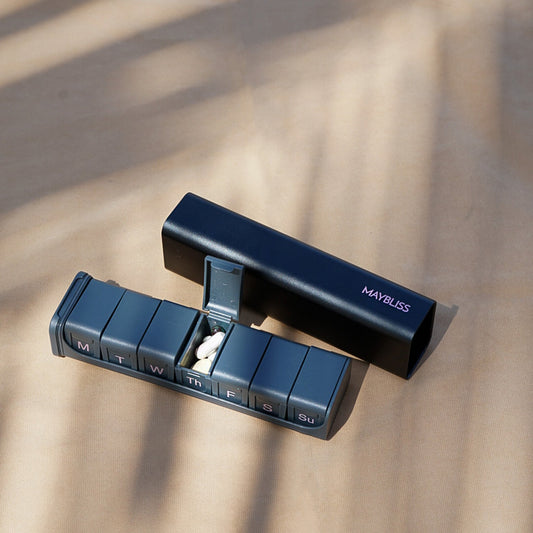
Maybliss approaches this with the BlissPod Pro, a patented magnetic pod-and-tray system designed to keep a full routine organized at home while making single-day portability feel refined rather than makeshift.
If you take supplements at different times, consider whether you need separate pods for AM and PM or compartments large enough to distinguish doses. Labels can be useful, but an intuitive physical system is better. The more your setup relies on tiny printed abbreviations and complicated rules, the less likely it is to hold up during a busy week.
What to Look for Before You Buy
Start with closure. A case should be secure enough for a commute or carry-on, not merely stable while sitting flat on a counter. Look closely at the lid design, the connection between compartments, and whether individual sections can open accidentally under pressure. A spill barrier is not glamorous until it saves a bag, a hotel room floor, or a carefully portioned week.
Then assess compartment size honestly. Large capsules, softgels, powders in small packets, and multiple tablets take up more room than people expect. Overstuffing a compartment can compromise the closure and turn a useful organizer into a frustrating one. If you have a substantial stack, choose a scalable system instead of trying to force everything into a tiny case.
Portability should not mean compromise. The ideal case is slim enough to bring along but substantial enough to withstand daily use. It should slide into a work bag, cosmetic pouch, or jacket pocket without feeling like medical equipment. Discretion has practical value: you are more likely to take your supplements consistently when the case looks appropriate in any setting.
Finally, consider cleaning and longevity. A case that is difficult to wipe out or has too many fragile moving parts will eventually become clutter. Smooth surfaces, durable finishes, and replaceable or expandable components make a difference over months of use.
Common Mistakes That Put Supplements at Risk
The first mistake is treating every supplement as equally travel-friendly. Some products are sensitive to light, heat, or moisture, while others should remain in their original packaging until use. Always follow the label, especially for prescription medication, probiotics, gummies, and formulas with specific storage requirements. A premium case supports organization, but it does not override manufacturer guidance.
The second is leaving a case in a hot car or direct sun. Anodized aluminum is durable and polished, but any portable container can heat up quickly in an enclosed vehicle. Pack your daily dose close to departure, keep it out of prolonged heat, and return the system to a cool, dry place when you get home.
The third is refilling without a reset. Once a week, empty any lingering pills, wipe the case according to its care instructions, and check that closures and compartments are working as intended. This takes minutes and keeps your setup as intentional as the supplements inside it.
Make the Case Part of the Ritual
The most effective vitamin case is the one that becomes automatic. Keep your home tray where your routine already happens: near your water glass, coffee setup, skincare shelf, or breakfast station. Refill on the same day each week. Take a single pod when you leave home. These small cues eliminate the familiar question of whether you remembered your supplements.
There is also a quieter benefit to upgrading the object itself. When your wellness tools are gorgeous, orderly, and made to last, the habit feels less clinical. You are not managing clutter. You are caring for a routine that supports how you want to feel.
Choose vitamin cases with the same discernment you bring to the supplements inside them. A secure, toxin-conscious, beautifully engineered system will not make every day perfect, but it can make your next healthy choice remarkably easy.